This week on Solana and SVM: Solana 1.0, DTCC heads to Solana, Samsung switches on USDC
Welcome to the first weekly roundup from Morsel. Every Monday we pick the developments that matter across Solana and the SVM networks, check them against their sources, and tell you what each one means inside your wallet. This week, the post-trade backbone of US markets said it will connect to Solana, Samsung put USDC on Solana in front of millions of Galaxy owners, and Breakpoint opened in London.
Solana 1.0: goodbye, mainnet beta
On 16 November the Solana Foundation announced Solana 1.0. The "mainnet beta" label the network has carried since it launched in March 2020 is retired: it is now simply Solana mainnet. Solana 1.0 is also the network's first shared protocol version, a number for the rules of the network that is separate from the release numbers of validator clients such as Agave and Firedancer, so every operator can see which rules their software supports. The Foundation says Solana has been a live production network since genesis, and points to the Alpenglow upgrade and Firedancer as the reasons the beta tag no longer fit.
For you: nothing to do. Your SOL, tokens, accounts and history stay exactly as they are, and Morsel works as before.
DTCC is connecting its tokenization service to Solana
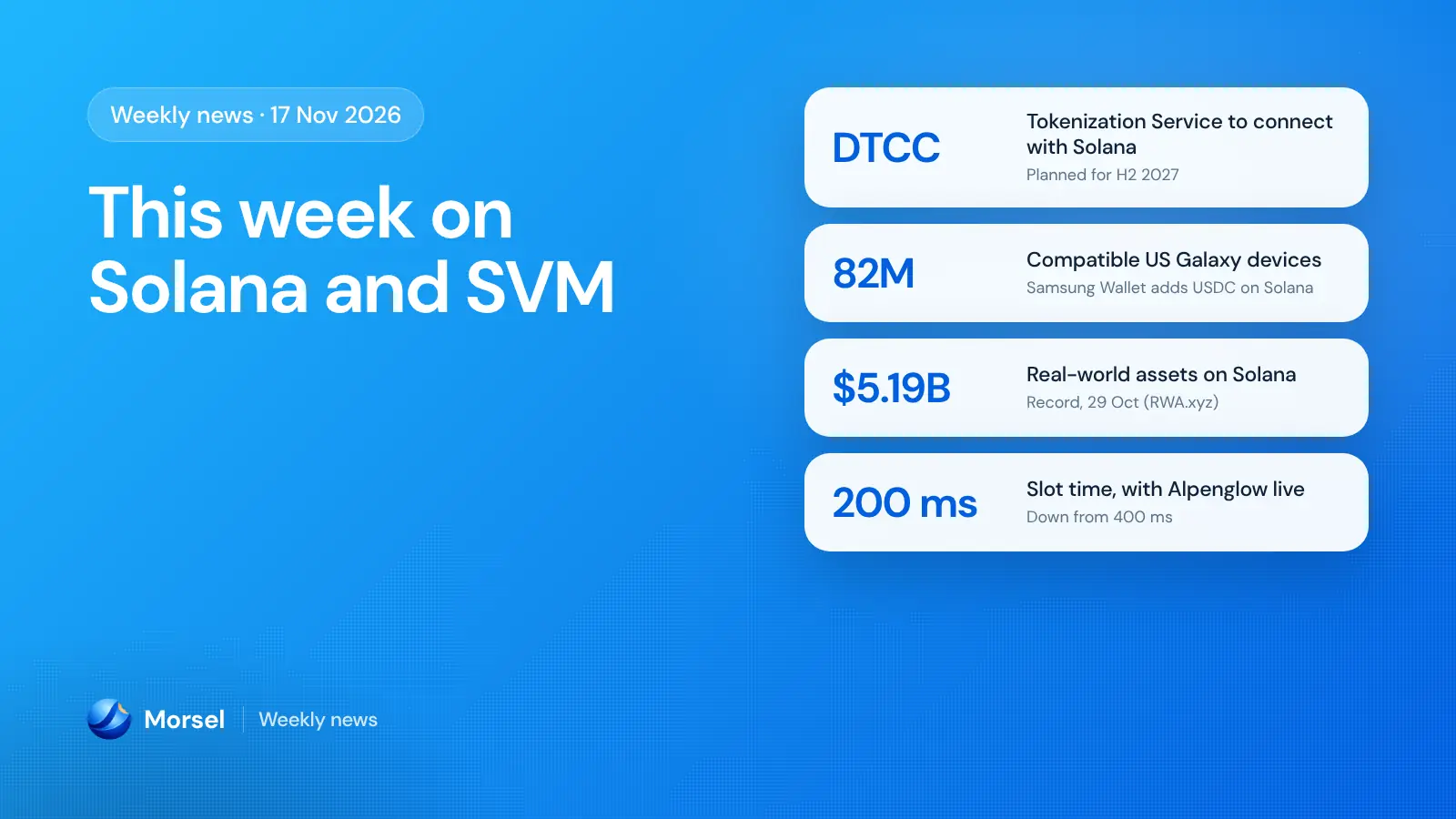
On 12 November the Depository Trust & Clearing Corporation, the post-trade infrastructure behind US securities markets, announced plans to let eligible assets held at DTC be tokenized on Solana. The DTCC Tokenization Service, which went live on 28 October, will connect to Solana's L1, with DTC-tokenized assets expected on Solana in the second half of 2027. DTCC says those tokens keep "the same investor protections, ownership rights and regulatory safeguards" as traditionally held securities.
For you: the biggest names in market plumbing are building on the same network your wallet runs on. Tokenized stocks are already here: in the Morsel app, the Stocks section of the DeFi tab lists tokens from xStocks, Backpack, Ondo and PreStocks, and you can buy them with any token you hold.
Samsung Wallet switched on USDC on Solana
Samsung's stablecoin feature, announced on 7 October, went live on 5 November. Eligible US Galaxy users can now buy, hold, send and receive USDC on Solana directly in Samsung Wallet, across about 82 million compatible devices. Samsung charges no fee to send USDC to compatible outside crypto wallets, and says more markets will follow, subject to local rules.
For you: it is the same USDC on Solana that Morsel holds, sends and swaps. Stablecoins on Solana keep getting easier to reach from the apps people already use.
Privacy Rings are live on Solana mainnet
Helius released Solana Privacy Rings on mainnet, announced by the Solana Foundation on 10 November. They are shielded pools that encrypt balances and amounts while wallets stay visible, for SOL, SPL and Token-2022 tokens. Decrypt, Ore and Aurora Intents are live at launch, Backpack, DFlow, Jupiter, Squads and Titan are integrating, and the programs and ZK circuits were audited by Certora, ZK Security and OtterSec.
For you: Private Mode on Privacy Rings is coming to Morsel. You will be able to keep a private balance in SOL, USDC and other tokens, and pay anyone with Private Mode switched on, Solflare users included, without the amount showing on chain. Until then, Morsel's Token-2022 private balances hide amounts for the tokens that support them.
Jupiter ships Baskets, Vaults and Portfolio V3
Ahead of Breakpoint, Jupiter rolled out four products on 10 November:
- Baskets: several tokens bought with one SOL or USDC deposit, weighted by market cap or fixed targets and rebalanced automatically.
- Vaults: yield strategies run by independent curators, in private beta from 11 November for eligible JUP stakers and a waitlist of more than 19,000.
- Portfolio V3: a rebuilt dashboard, live now, with alerts for positions near liquidation.
- Pulse and rebuilt token pages, including data for tokenized stocks and ETFs.
Jupiter says its aggregator has processed more than $1.3 trillion in cumulative volume.
For you: swaps on Solana in Morsel are routed through Jupiter, Jupiter perps sit in the DeFi tab next to Pacifica and Phoenix, and Jupiter Lend is in Earn. The new products live on jup.ag, which opens in Morsel's built-in browser.
October closed with records
Real-world assets on Solana hit a record of about $5.19 billion on 29 October, per RWA.xyz data, up from about $4.39 billion in mid-October. The Solana Foundation's October roundup also counts $60 billion in DEX volume for the month, and in October stablecoin holders on Solana passed 14 million addresses, an all-time high.
For you: more of what you can own on chain lives on Solana every month, and Morsel keeps it together: stablecoins and tokens on Home, tokenized stocks in the DeFi tab.
A faster Solana, now settling in
Solana spent the autumn getting quicker. The target slot time came down from 400 ms to 200 ms in four steps, the last on 9 October (Solana Foundation). Then on 21 October Anza's Alpenglow consensus went live on mainnet at slot 459,653,000, replacing TowerBFT and designed to cut finality from about 12.8 seconds to about 150 milliseconds.
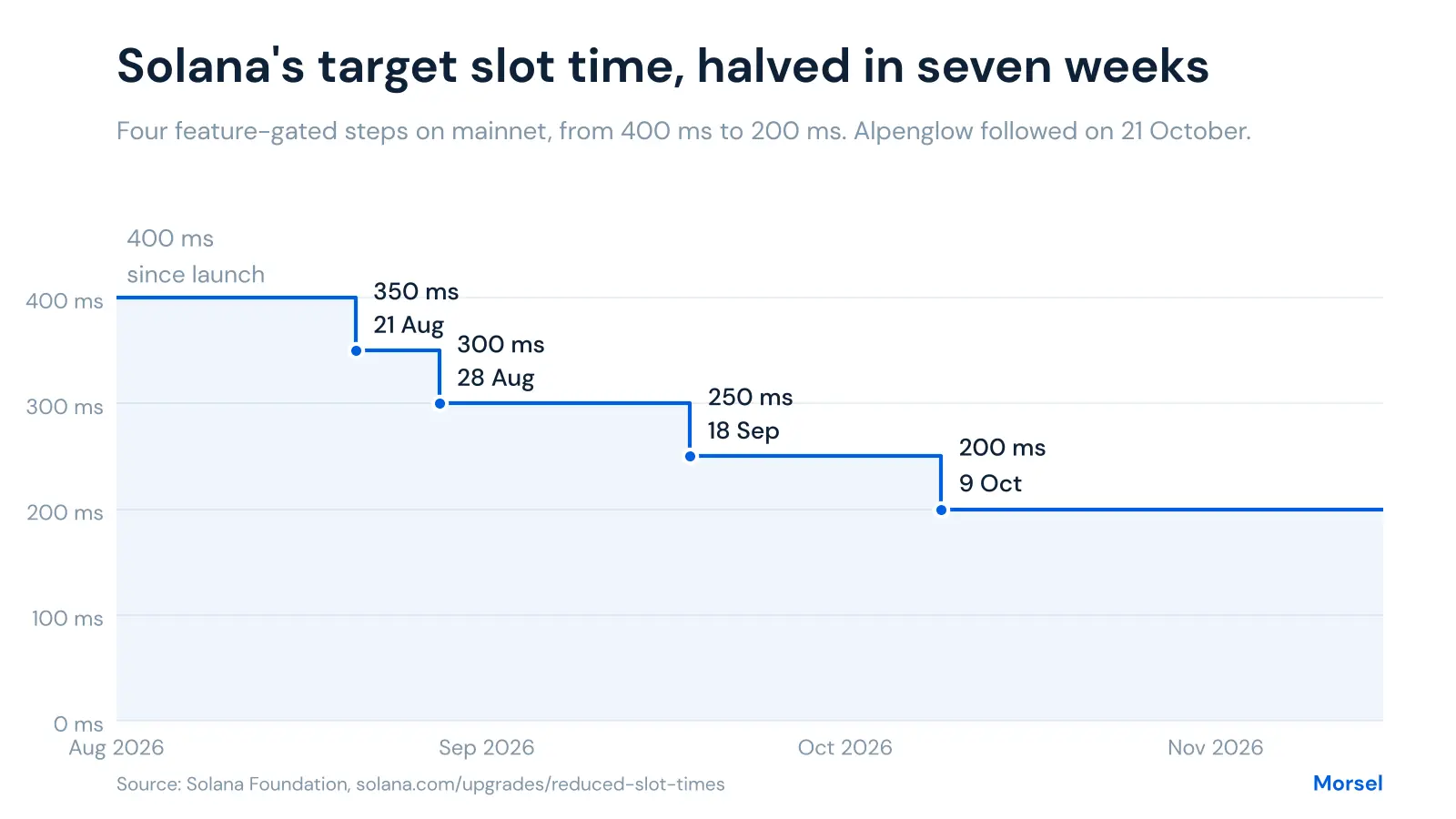
Chart: Solana's target slot time in 2026. Source: Solana Foundation, Reduced slot times.
For you: every send, swap and bridge you make on Solana in Morsel now runs on a network built to finalize in a fraction of a second.
Breakpoint opens in London
Solana's flagship conference opened on 15 November at Olympia London and runs until 17 November, the first Breakpoint held in Europe. Day one centres on institutions and tokenized assets, day two on consumer apps and AI, with speakers including Anatoly Yakovenko, Raj Gokal and Lily Liu, and executives from Barclays, Mastercard and Western Union.
For you: we are following every session. The announcements that reach your wallet will be in next week's roundup.
Across the SVM networks
Cookie Chain upgraded its validators. On 10 November the Cookie Chain team released Cookie v4.1.3, the network's own build of the Agave validator client, and Morsel's check of the network on 16 November found every voting validator running it and identifying itself as the Cookie client. The release adds feature switches that let the community's Squads multisig turn on Solana features on Cookie Chain, so no single person has to hold a feature's key. It also prepares two program upgrades: p-token 1.0.0, a more efficient token program, and the newer stake program, both loaded from buffers the multisig controls and switched on in later steps.
For you: nothing to do. Until the multisig switches a feature on, Cookie Chain runs exactly as before, and your COOK, tokens and stake in Morsel are unaffected.
X1 has moved to Tachyon v4.0.4. On 6 November X1 Labs released Tachyon v4.0.4, a security release for its validator client that backports the upstream fix Anza shipped in Agave v4.4.1, clears six dependency advisories and adds one new feature gate. Morsel's check of the network on 16 November found 354 of the 371 nodes it could see already on v4.0.4, and the new gate, which charges a program's data account at least its metadata size, switched on at the start of epoch 437.
Fogo runs v20.0.0 of its Firedancer-based client. According to Fogo's release notes, v20.0.0 adds native token wrapping and transfers with Fogo Sessions, moves gossip and repair traffic to XDP and shortens runs of consecutive leader slots. Morsel's check of the network on 16 November found all 36 nodes it could see on v20.0.0.
Sonic SVM's token is back on KuCoin. On 29 October KuCoin opened spot trading for SONIC against USDT, its return to the exchange after a delisting in August. Morsel's check on 16 November found Sonic SVM's mainnet alpha producing blocks on version 2.3.0.
Solayer: about 30.77 million LAYER tokens were scheduled to unlock on 11 November, per RootData data reported by ChainCatcher. Morsel's check on 16 November found the InfiniSVM mainnet answering and producing blocks.
For you: all five networks are in Morsel. Cookie Chain and Fogo are on by default, and X1, Sonic SVM and Solayer can be switched on in Settings › Manage networks.
Not financial advice. Sources linked.